|
Sno Cat
- Nodwell Crane | Ski
Doo | Bulldozer | Snow Blower
The Sno Cat was the main workhorse of the base. We were located about 15km
inland, so the sno cats were responsible for getting all of the supplies
(including personnel) from the coast up to base. They have four big rubber
tracks with metal teeth to grip on the snow & ice. They are 4 track drive & 4
track steer, to aid manoeuvrability and there was a great big engine under the
bonnet. If you would like find out more about sno cats, check out the
Tucker website.
We had quite a few cats on base, but only the oldest, most rickety cats were
operated on the sea ice. It is not unknown for them to go for the odd swim.
Consequently each sno cat has a standard British Antarctic Survey modification -
an escape hatch in the roof. When driving on sea ice, this hatch is left open to
ease escape.
When a lot of people needed a lift, we would often end up sitting on the
sledge behind the sno cat. With 4 big tracks churning up the snow, the
passengers usually ended up snowed in.
In the cold winter, the sno cats are left hooked up to electrical heaters to
keep the oil in the transmission, gearbox & engine slightly less solid. Even
with this precaution, it would take a couple of hours to warm a sno cat up to
operating temperature. When I say operating temperature I don't, of course, mean
a human operating temperature. Even in the cab it was really cold so thick
clothing was a must either inside or outside the sno cat when it was -30C
outside.
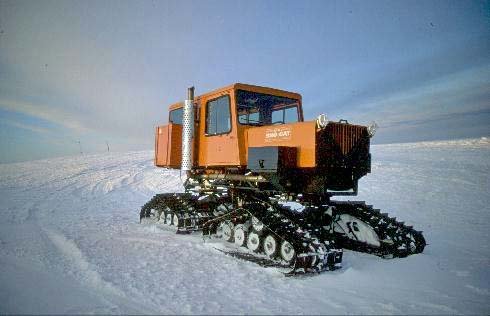 |
This handsome fellow was the sno cat that
I used 12 hours a day for two weeks when I arrived at Halley, during the
hectic unloading of ships cargo. The trip from base to ship was about an
hour each way. You would set off with an empty sledge, trundling across the
ever worsening snow surface ( as you can imagine, the route between base &
ship got churned up into a very nasty lumpy mess after a couple of days)
trying to stay awake with very little to keep the interest up (Halley was
flat so all I could see was a line of 45 gallon drums disappearing into the
distance). Upon arrival, I would unhitch the empty sledge & hook up to a
full one in the blinking of an eye & then set off for the return leg.
Trundling along with nothing to look at but snow and oil drums.
Occasionally, I would pass another cat & give a wave. Tedious, but necessary
work.
In the summer when there was no sea ice at the coast, the ship couldn't
unload so the unfortunate drivers had a 4 hour each way trip to the low ice
shelf further up the coast at N9. |
 |
Sno cats are surprisingly agile. An
excellent design for these conditions. This one was being driven by the
mechanic, who was showing off what his baby could do. This was my second
winter & I wouldn't have though of going up such a steep slope until I saw
him do it. Antarctica is full of surprises. The amount of snow stuck to
the cat indicates that this was a cold winters day. The picture above shows
no snow stuck to the cat, so it was taken in the summer. |
 |
This is one of the older sno cats that
only came out in the summer to work on the sea ice. It only has two seats,
so is only suited to hauling sledges. |
|
 |
Here are the summer cats in a line. The
one on the right is a sno groomer. The cab is on backwards & it has a
little bulldozer blade on the front. This was used to maintain the ramp
down from the ice shelf to the sea ice. The ramp suffered quite badly due
to the amount of traffic when unloading the ship. Next along is another
specialist. The green arm above the cat is a cherry picker (hydraulic
platform), used in the summer when maintaining the buildings.
All these vehicles started out the winter on a mound about 2 metres
high. After a few months of storms, the snow accumulated around the
mounds, than over the vehicles. This is not a problem for the vehicles. |
|
